Basic Organization Ideas
Positional Responsibilities and Duties
Team Communication
Final Thoughts
Introduction
I would like to preface this article by saying that what I present here is based on my own experiences and training, as well as some standards as adopted by various militaries and agencies. Many of you have far more experience than I do, and I am always willing and anxious to hear what others might offer based on their experiences.
The organization of a two man team may seem like something that is either not worth spending effort on, or something so easy that limited discussion needs to be devoted to it. And while yes, it can be simple and straight forward, it still warrants spending a little bit of discussion time on. A clear definition of the organization of the team and its various duties and SOP's for the team and each member goes a long way to helping the team operate efficiently and effectively. Just like team sports, or even more relevantly, a combat team, a sniper team is most effective when operating as a team with each team member supporting the other by doing their specific tasks as best as possible and doing what ever it takes for the team to succeed. Clearly defining those responsibilities and roles, and then training, training, and more training to perfect the execution of those responsibilities is what will make an effective team.
The concept of a sniper and his lone presence in the battlefield as well as the glory of the "confirmed kill" and its recognition can sometimes be a detriment to the effectiveness of a team. Only by putting aside the quest for personal glory and accolades by each member will the team truly meet its peek effectiveness. By having a defined set of SOPs and responsibilities it can help build the cohesiveness of the team by eliminating any question of who takes the shot and allows the team to focus on their various responsibilities at that given time. In these regards, I would personally prefer that the "team" be given any accolades or "tally", as each person in that team is equally responsible for any accomplishments or failures of the team.
Basic Organization Ideas
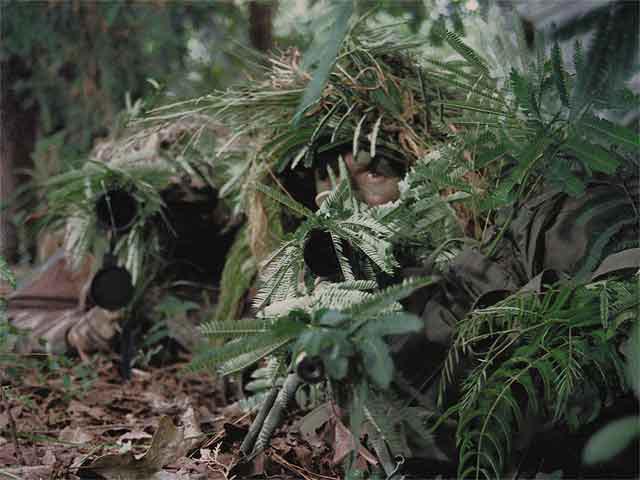
The first element to discuss is the team size. Through WWI and WWII it became obvious through experience and research that a two man team was much more effective than a single sniper. The Russians are credited with the concept of the modern two man sniper team. The two man team shares responsibilities for security, observation, and other stresses. They also support each other psychologically and also work together as a shooter/coach pair comparing notes and averaging range estimations, etc. Both team members must be fully qualified snipers, able to perform both duties and it is probably obvious that the two members should get along fairly well.
While the organization of a two man team may seem easy to setup, there is a bit more process involved than one might think. The obvious arrangement of "Sniper" and "Observer" seems a logical solution at the outset, but in reality, things never tend to be that simple. While the team is operating, there is indeed a shooter and a spotter/coach, but arriving at the conclusion of who is behind the rifle and who is behind the spotting scope at that particular time is the tricky part.
While it may seem contrary to common thinking from those outside of the sniping community, you generally want the most experienced person behind the spotting scope, not the rifle. The reason is because the spotter is responsible for calling the wind, scope adjustments, weather adjustments, final range and whether to engage or not. All of these facets require considerable experience to do effectively. It can be especially important when dealing in limited Rules Of Engagement (ROE) situations where a command decision has to be made that can be critical. Experience is crucial, as well as rank if it comes down to the technicalities.
Effectively, there should be a team leader and a team member. As I will discuss below, the roles during a particular engagement will alternate. The team leader is just that, the leader who is ultimately responsible for the teams success or failure. He is the final say in the field and also when in garrison. The other team member may not ultimately be responsible, but does share in helping to make the judgment calls, and as I mentioned before, needs to be fully qualified as a sniper. Together, the teammates determine the success of the team. The team leader is also the one who heads up the training of team specifically and works with the Sniper Employment Officer in regards to this training and needs of the team. Obviously, if a team is part of a sniper section, normal chain of command falls into place in regards to training and decisions.
Generally, no unit smaller than the 2 man sniper team should be considered. For operations that may require larger elements, teams can be combined to form larger sniper units, but specific teams should not be split up. Teams can also have other detachments attached to them for security or insertion/stay behind operations. The command of these larger elements should remain with the sniper team leader, and these larger attached elements should provide enough distance on final operating areas to give the sniper team freedom of movement without detection. Usually 1000+ meters when possible.
Positional Responsibilities and Duties
The duties of each of the two positions of shooter and spotter/observer are fairly well defined. A fairly good breakdown comes from the US Army FM23-10 "Sniper Training" manual and are as follows:
Sniper:
- Builds a steady, comfortable position.
- Locates and identifies the designated target.
- Estimates the range to the target
- Dials in the proper elevation and windage to engage the target.
- Notifies the observer of readiness to fire.
- Takes aim at the designated target
- Controls breathing at natural respiratory pause.
- Executes proper trigger control.
- Follows through.
- Makes an accurate and timely shot call.
- Prepares to fire subsequent shots, if necessary.
- Properly positions himself.
- Selects an appropriate target.
- Assists in range estimation.
- Calculates the effect of existing weather conditions on ballistics.
- Reports sight adjustment data to the sniper.
- Uses the M49/M144 observation telescope for shot observation.
- Critiques performance.
The item "Critiques performance" refers to reporting the results of the engagement to the sniper and what corrections need to be made, if any. This relies heavily on reading the trace to know where bullet impact is. It is amazing how rare it really is to see bullet impact, especially at longer ranges, which is why relying on trace is so important.
Through the course of an operation, the role of spotter/observer should be routinely cycled. The stress is different in both positions, as well as the level of strain on the eyes when observing through optics. By routinely switching it allows for fresh eyes and mind to take over each respective role. SOP should dictate when this should happen. A common and easy method is to do it on the hour when in a FFP/Hide. When moving and not stationary, the switch is not as important but may still be desirable. That would just be a part of the teams SOP and how they, or the team leader, decides to handle it. An important point is to know that who ever is behind the rifle when the engagement begins, is the one who is taking the shot. There should not be any switching of gear during a critical engagement to get a specific person behind the rifle. Again, having this outlined clearly in the SOP can prevent some problems when it is critical.
Team Communication
What isn't really outlined very well in the list of duties is the communication and dialog that happens between the two team members. The whole process of range estimation and weather effects calculation is a dialog that happens by the sniper giving a mil reading, the observer calculating the range and telling the sniper the exact elevation adjustment to use based on the current situation and taking into account things like temperature change from zero, humidity difference, uphill/downhill angle, ammunition used, and other factors that are recorded in the teams log book. The range is given, as well as an estimate on the wind and the scope corrections for that. The sniper also has to indicate when he is ready to fire, with the observer giving the final command to fire, or hold.
As the team matures and works together a pattern and means of communication develops. Some teams use the number of MOA when calling scope corrections; some indicate the number of "clicks" instead. Some teams' communicate using grunts and groans when preparing to fire, others whisper. This process of communication develops naturally and there is no single right way to do it. Just what ever works best for each team as long as it is clearly understood.
Final Thoughts
The sniper team MUST become a fairly close and tight knit small team. It is critical that clear SOP's and procedures be well versed and known between the team members. This communication and clear definition of responsibilities can be a life saver and difference maker in the field. Training together is obviously critical for a sniper team and should be conducted as much as possible so many of these team things can be ironed out during training and not during combat. Having them written can also help keep things clear and bring new team members up to speed as quick as possible.